



Patients rarely choose a provider after one interaction. They search symptoms on Google, scroll through social media, read reviews, open an email reminder, and maybe spot a flyer in a waiting room—all before booking an appointment. To meet patients at each of these moments, healthcare organizations need more than a single advertising effort. They need well-coordinated multi-channel healthcare marketing campaigns.
This guide breaks down what multi-channel marketing means in a medical context, how it differs from omnichannel healthcare marketing, and which channels deliver the strongest results. You will learn how to build a healthcare marketing strategy from the ground up, measure what matters, and avoid the compliance pitfalls that trip up so many medical practices. By the end, you will have a practical framework for designing patient engagement campaigns that actually move the needle.
Whether you run a small clinic or manage marketing for a large health system, the principles here apply. Let’s get into it.
What are multi-channel healthcare marketing campaigns?
Multi-channel healthcare marketing campaigns are coordinated efforts that promote a medical practice, service, or health message across two or more communication channels. These channels might include search engines, social media, email, paid advertising, print media, television, radio, and community events.
The goal is simple: reach patients where they already spend their time. Some patients respond to a Facebook post. Others click a Google ad. Older patients may prefer a printed brochure or a phone call. By using multiple channels at once, a healthcare organization increases the odds of connecting with each patient in a way that feels natural to them.
A strong multi-channel approach does not treat each channel as a separate island. Instead, it weaves them together so the messaging stays consistent—even if the format changes from a tweet to a TV spot.
What is the difference between multi-channel and omnichannel healthcare marketing?
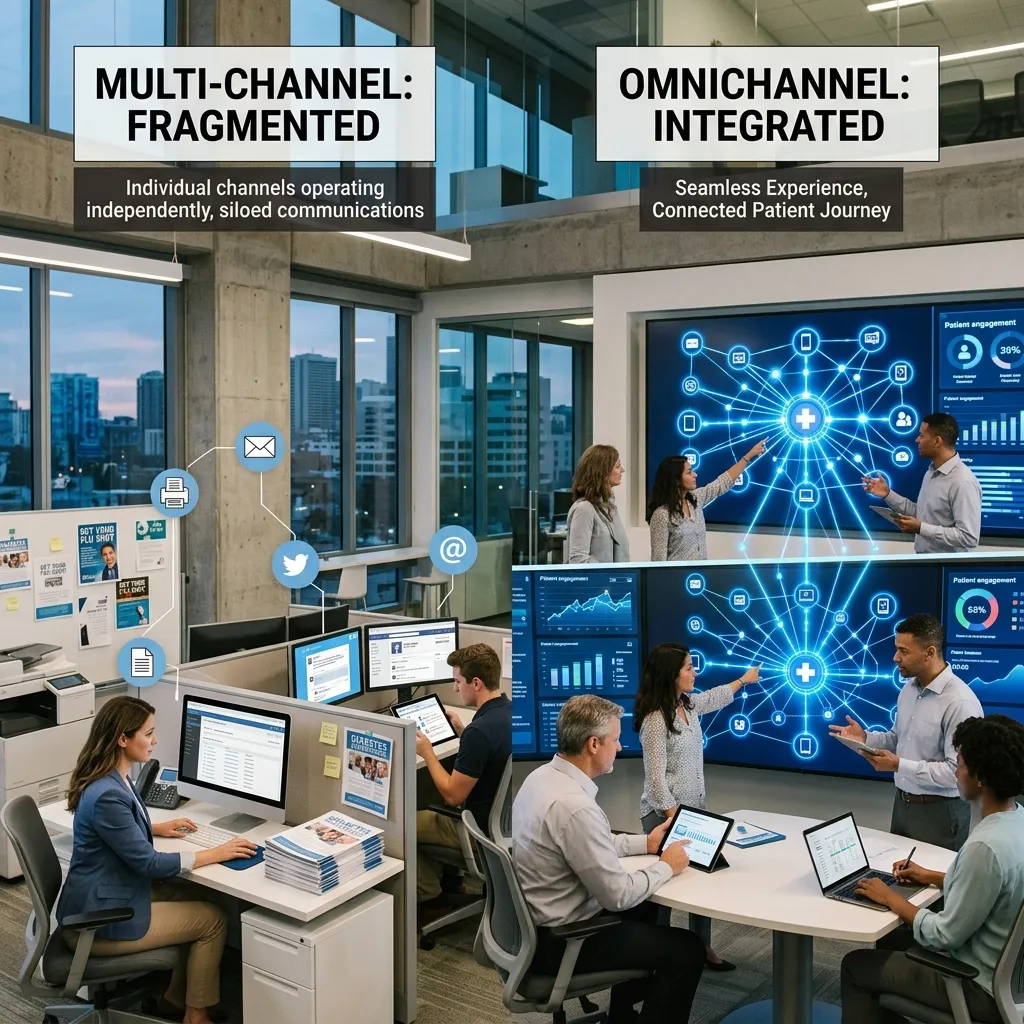 The terms multi-channel and omnichannel are often used interchangeably, but they describe different things. Understanding the distinction helps you design better patient engagement campaigns.
What is multi-channel marketing?
Multi-channel marketing uses several independent channels to reach patients. Each channel—email, social media, paid search—operates on its own track with its own message. The focus is on broadcasting your message across as many touchpoints as possible. A patient might see your Instagram post and later receive an email, but those two experiences may not be connected behind the scenes.
What is omnichannel healthcare marketing?
Omnichannel healthcare marketing goes a step further. It connects every channel into one seamless, patient-centered experience. The data flows between channels, so a patient who books a consultation online receives a tailored email follow-up, then a text reminder that reflects exactly where they are in their journey. The patient feels like they are interacting with one organization, not five disconnected departments.
Why does the distinction matter for patient engagement campaigns?
Multi-channel marketing widens your reach. Omnichannel marketing deepens the relationship. Choose multi-channel campaigns if your priority is awareness and you are just starting to expand your visibility. Move toward omnichannel when patient retention and personalized communication matter more than raw reach. Most practices start multi-channel and evolve toward omnichannel as their technology and data capabilities grow.
What are the key components of successful multi-channel healthcare marketing campaigns?
A high-performing campaign blends digital and traditional channels. Here is how each piece fits into a complete healthcare marketing strategy.
Which digital channels work best for healthcare marketing?
Digital channels reach patients exactly when they are searching for answers, which makes them the backbone of most modern campaigns.
- Search Engine Optimization (SEO): Patients begin their healthcare journey on Google. Optimizing your site for intent-driven keywords—like “pediatric dermatologist near me”—helps your practice appear at the top of local results. Dedicated pages for each treatment and condition improve how search engines index your site.
- Content marketing: Blogs, videos, and infographics answer patient questions and build authority. A clear video explaining a procedure can ease anxiety and turn a researcher into a booked appointment.
- Social media marketing: Platforms like Facebook, Instagram, and TikTok humanize your practice. Share wellness tips, staff introductions, and patient success stories—always within platform advertising rules and privacy guidelines.
- Email marketing: Segmentation and personalization make email one of the most cost-effective channels. Automated newsletters, appointment reminders, and post-visit follow-ups keep your practice top of mind.
- Paid advertising (PPC and social ads): Google Ads capture high-intent searches like “urgent care near me,” while social ads target patients by location, age, and interests. Paid channels deliver immediate visibility while SEO builds over time.
- Website and landing page optimization: Every campaign funnels patients to your website. Fast load times, mobile-friendly design, clear calls to action, and secure online booking turn visitors into patients. Mapping these touchpoints into a clinic marketing funnel keeps the entire patient journey organized.
Do traditional channels still matter in healthcare marketing?
Yes. Digital may dominate, but traditional channels still reach important audiences and build local trust.
- Print advertising: Brochures in waiting rooms and ads in local magazines reach older demographics and reinforce brand awareness.
- Television and radio ads: These build broad awareness across a community, especially for hospitals and large health systems.
- Public relations and media outreach: Expert commentary in local news boosts credibility and expands reach.
- Community events and sponsorships: Health fairs, screenings, and seminars let patients meet your team and experience your brand in person—often building trust faster than any online tactic.
How do you bridge digital and traditional channels?
An integrated approach ties everything together. The message on your printed flyer should match the information on your website. A radio ad should point listeners to a landing page that continues the conversation. Building an integrated healthcare marketing strategy ensures every channel reinforces the others rather than competing for attention.
How do you develop a multi-channel healthcare marketing strategy?
 A successful campaign starts with planning, not posting. Follow these steps to build a strategy that lasts.
How do you define your target audience and patient personas?
Begin by identifying who you serve. A pediatric clinic markets very differently than a cardiology practice. Build detailed patient personas that capture demographics, health concerns, and online behaviors. Add psychographics—values, fears, and lifestyle—to make your messaging resonate. When you know what questions patients ask, you can create content that answers them directly.
How do you set clear goals and KPIs for patient engagement?
Decide what success looks like before launching. Common goals include new patient acquisition, appointment bookings, or awareness for a specific service. Tie each goal to measurable KPIs: website traffic, conversion rates, email open rates, cost per acquisition, and patient retention. Clear metrics keep your campaign accountable.
How do you select the right channels?
Match channels to your audience and goals. If you serve younger patients, prioritize Instagram and TikTok. If you serve older patients, blend print, phone, and email. High-intent services benefit from Google Ads, while long-term growth comes from SEO and content. You do not need every channel—just the right ones.
How do you build a content strategy across channels?
Plan content that adapts to each platform while keeping one core message. A single educational topic can become a blog post, a short video, a series of social posts, and an email. This repurposing approach saves resources and reinforces your message through repetition.
How do you allocate budget and resources?
Prioritize channels with the highest return on investment. Local SEO and email retention campaigns often deliver strong returns at low cost. Once these foundations generate revenue, reinvest profits into paid advertising to scale. Smaller practices should start with one or two channels they can execute well.
How do you use data and analytics to optimize?
Data turns guesswork into strategy. Review analytics dashboards regularly to see which channels drive bookings and which fall flat. Use these insights to shift budget, refine messaging, and improve continuously.
How do you implement and measure multi-channel healthcare campaigns?
Strategy means little without strong execution. Here is how to bring your campaign to life and prove its value.
How do you craft compelling messages for each channel?
Tailor your message to the format. A Google ad needs a sharp, keyword-rich headline. A social post needs an emotional hook. An email needs a clear subject line and a single call to action. The tone shifts, but the core promise stays the same.
How do you maintain brand consistency across touchpoints?
Patients should recognize your brand instantly, whether they see a billboard or a tweet. Use consistent logos, colors, voice, and messaging everywhere. This consistency is what builds trust over repeated exposures.
What role does marketing technology play?
Marketing automation and a healthcare-compliant CRM keep campaigns running smoothly. These tools track patient interactions, manage leads, automate email sequences, and reduce the administrative load on your front desk. According to the U.S. Department of Health & Human Services, any platform handling patient data must use secure, encrypted transmission to stay HIPAA-compliant.
How do you measure and analyze campaign performance?
Track performance against the KPIs you set earlier. Connect your booking system to your analytics so you can trace each appointment back to its source. This shows you exactly which channels generate revenue, not just clicks.
Why is iteration important?
No campaign is perfect at launch. A/B test headlines, images, and landing pages. Make small, data-driven adjustments over time. These incremental improvements compound into significant gains.
What are the biggest challenges in multi-channel healthcare marketing?
 Healthcare marketing carries unique hurdles. Knowing them in advance helps you plan around them.
How do you stay HIPAA-compliant?
Compliance is non-negotiable. Every channel that touches patient data must protect it. Use HIPAA-compliant software, secure your website with encryption, obtain clear consent before sending marketing emails, and avoid guaranteed-outcome claims in your copy. Choosing the right healthcare communication channels helps protect patient privacy at every step. Always consult legal counsel to confirm your practices meet local advertising laws.
How do you avoid data silos?
When channels operate in isolation, valuable patient data gets trapped. Integrate your systems through a central CRM or EHR so information flows freely. Connected data creates a smoother patient experience and sharper marketing decisions.
How do small clinics handle resource constraints?
Limited budgets and small teams are common. Focus on a few high-return channels rather than spreading yourself thin. Automation tools and content repurposing stretch limited resources further. Start small, prove results, then scale.
How do you measure ROI across complex campaigns?
Attribution is tricky when patients touch multiple channels before booking. Use tracking tools, unique phone numbers, and source-tagged landing pages to assign credit accurately. Focus on metrics like cost per booking and patient lifetime value to understand true return.
What do effective multi-channel healthcare campaigns look like?
Real-world examples show how these principles come together.
Example 1: Patient acquisition for a specialist clinic
A specialist clinic combines local SEO, Google Ads, and a targeted email sequence. Search ads capture patients actively looking for the specialty, the optimized website converts them with clear booking options, and follow-up emails nurture those who do not book immediately. The result is a steady pipeline of qualified appointments.
Example 2: Health awareness and education program
A public health campaign blends social media, content marketing, and community events. Educational videos and infographics spread across platforms, a dedicated landing page houses resources, and in-person screenings turn awareness into action. The multi-channel mix reaches both digital natives and traditional audiences.
Example 3: Telehealth service promotion
A practice launching telehealth uses paid social ads, email outreach, and SMS reminders. Social ads build awareness of the new service, emails explain how it works, and texts make booking effortless. The coordinated push drives rapid adoption.
How will multi-channel healthcare marketing evolve?
The future of healthcare marketing centers on personalization and intelligent technology.
What role will AI and personalization play?
Artificial intelligence already segments email lists, personalizes website content, and optimizes ad spend in real time. As AI tools mature, they will deliver increasingly tailored experiences to each patient, making campaigns more efficient and more relevant.
What emerging technologies should you watch?
Voice search, chatbots, remote monitoring, and AI-generated search results are reshaping how patients find care. Structuring your content to answer direct questions helps your practice surface in these new formats.
How do you keep a patient-centric approach?
Technology should serve patients, not overwhelm them. The most successful campaigns stay grounded in empathy—delivering helpful, honest, and accessible information at every touchpoint.
Bringing your multi-channel strategy together
 Multi-channel healthcare marketing campaigns work because patients no longer follow a single path to care. They move between Google, social media, email, and the real world before they ever book an appointment. By meeting them at each step with consistent, trustworthy messaging, your practice builds the kind of relationships that drive long-term growth.
Start by understanding your patients deeply. Choose the channels that match their habits, set clear goals, and measure relentlessly. Lean on an integrated healthcare marketing strategy so every channel reinforces the others, and never lose sight of compliance and patient privacy.
Pick one or two channels you can execute well, track your results, and expand from there. Sustainable growth comes from consistency, measurement, and a genuine commitment to patient value.
Conclusion
Multi-channel healthcare marketing campaigns help healthcare organizations reach patients more effectively by combining digital and traditional communication channels. By delivering consistent messaging, improving patient engagement, and maintaining HIPAA compliance, providers can build trust and strengthen relationships across every touchpoint. With a well-planned healthcare marketing strategy, organizations can increase bookings, enhance patient experiences, and achieve long-term growth in an increasingly competitive healthcare landscape.
Frequently Asked Questions
1. What is the main difference between multi-channel and omnichannel healthcare marketing?
Multi-channel marketing uses several independent channels to broadcast your message and widen reach. Omnichannel marketing connects those channels into one seamless, data-driven experience centered on the individual patient. Multi-channel focuses on reach; omnichannel focuses on a unified relationship.
2. How can I measure the ROI of my multi-channel healthcare campaigns?
Connect your booking system to your analytics and use source-tagged landing pages, unique phone numbers, and tracking tools to attribute appointments to specific channels. Focus on metrics like cost per booking, conversion rate, and patient lifetime value rather than clicks alone.
3. What are the most effective digital channels for healthcare marketing?
Local SEO, content marketing, email marketing, paid search (Google Ads), and social media consistently deliver the strongest results. The best mix depends on your audience—younger patients favor social platforms, while older patients respond well to email and search.
4. How do I ensure HIPAA compliance in my multi-channel efforts?
Use HIPAA-compliant software for all patient data, secure your website with encryption, obtain explicit consent before sending marketing emails, and avoid guaranteed-outcome claims. Always verify your practices with legal counsel and refer to official HHS guidance.
5. What role does content play in multi-channel healthcare marketing?
Content is the fuel for every channel. A single educational topic can become a blog post, video, social series, and email. Quality content builds authority, improves SEO, and gives patients the information they need to choose your practice with confidence.
6. How often should I update my multi-channel strategy?
Review analytics monthly to spot trends and make small adjustments. Conduct a deeper strategy review quarterly, and reassess your full channel mix at least once a year or whenever your goals, audience, or technology change significantly.
7. What are common mistakes to avoid in multi-channel healthcare campaigns?
Common mistakes include inconsistent messaging across channels, ignoring compliance requirements, spreading a small budget too thin, neglecting data integration, and failing to track results. Focus on a few channels you can execute well before expanding.
8. How can small clinics implement a multi-channel strategy effectively?
Small clinics should start with high-return, low-cost channels like local SEO and email. Use automation and content repurposing to stretch resources. Prove results with one or two channels, then reinvest profits to add more over time.
9. What is the importance of patient engagement in multi-channel marketing?
Patient engagement turns one-time visitors into loyal, returning patients. Engaged patients attend appointments, follow care plans, leave reviews, and refer others. Multi-channel campaigns sustain engagement by communicating consistently across the channels patients prefer.
10. Where can I find more resources on healthcare marketing strategy?
Explore detailed guides on building a clinic marketing funnel, creating an integrated healthcare marketing strategy, and choosing the right healthcare communication channels. For compliance, consult the U.S. Department of Health & Human Services.
