



The 6 communication channels in clinical research ensure effective collaboration among investigators, sponsors, patients, regulators, and data teams. These channels support patient safety, regulatory compliance, data integrity, and efficient trial operations, helping clinical studies achieve reliable and successful outcomes.
Clinical trials don’t fail because of bad science alone. More often, they break down because of miscommunication—between sponsors and sites, between investigators and patients, between data managers and statisticians. The 6 communication channels in clinical research form the backbone of every successful trial, and understanding each one is essential for anyone working in or alongside the clinical research ecosystem.
Communication in clinical trials is not a soft skill. It is a regulatory requirement, a patient safety mechanism, and a data integrity safeguard all at once. When communication fails at any point in the trial process, the consequences can range from protocol deviations and delayed submissions to serious adverse events going unreported. Getting it right requires deliberate structure, clearly defined responsibilities, and the right tools for each channel.
This post breaks down each of the 6 communication channels in clinical research, explaining what each channel involves, why it matters, and what best practices look like in practice. Whether you are a clinical research associate, a principal investigator, a sponsor representative, or a site coordinator, this guide will help you communicate more effectively at every stage of a trial.
For a broader view of how communication infrastructure supports healthcare delivery, the Healthcare Communication Channels: A Complete Guide provides helpful context on how structured communication systems drive better outcomes across clinical settings.
What are the 6 communication channels in clinical research?
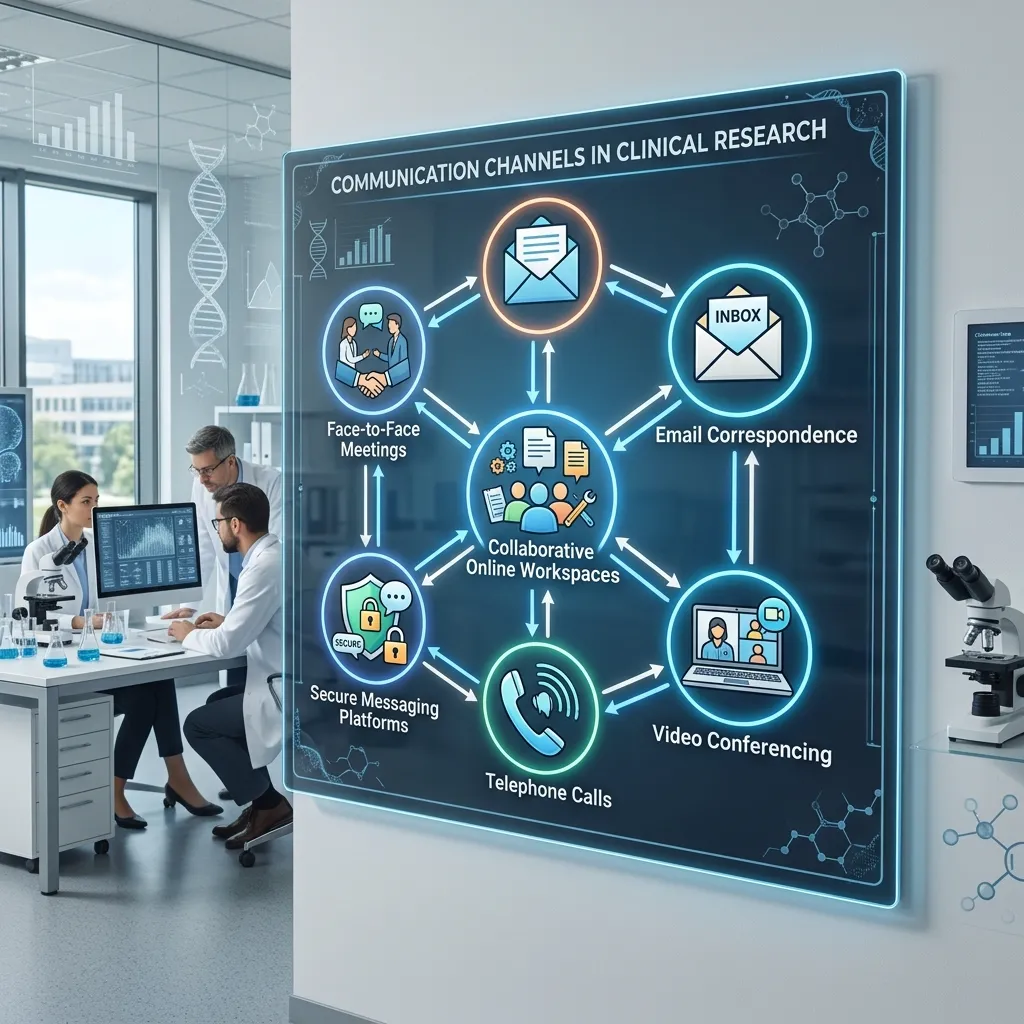 The 6 communication channels in clinical research are:
- Investigator-site communication
- Sponsor-CRO-site communication
- Patient-investigator and study staff communication
- Regulatory communication
- Data management and statistical communication
- Inter-departmental and cross-functional communication
Each channel operates within a distinct relationship, carries its own documentation requirements, and demands a tailored communication approach. Together, they create the information flow that keeps a clinical trial on track from protocol development through to final reporting.
Channel 1: What does investigator-site communication involve in clinical trials?
Investigator-site communication refers to the ongoing exchange of information between the sponsor or contract research organization (CRO) and the clinical site team—including the principal investigator (PI), sub-investigators, site coordinators, and support staff.
This channel begins before the trial starts and continues until the site is formally closed. Site initiation visits (SIVs) establish the foundation, ensuring that all site personnel understand the protocol, their responsibilities, and the regulatory requirements. Monitoring visits—conducted either on-site or remotely—then serve as the primary mechanism for ongoing oversight. Between visits, routine correspondence via email, phone calls, and electronic data capture (EDC) platform queries keeps communication flowing.
Key components of effective investigator-site communication include:
- Site initiation visits: Comprehensive training sessions that align site staff on protocol requirements, documentation standards, and adverse event reporting procedures
- Monitoring visits: Structured reviews of source documents, case report forms, and regulatory binders to verify data accuracy and protocol compliance
- Routine correspondence: Email updates, site newsletters, and query management through EDC systems that maintain continuous dialogue between visits
Common challenges include high site staff turnover, inconsistent documentation practices, and communication delays during urgent safety reporting. Best practices center on establishing a single point of contact at each site, maintaining clear escalation pathways, and documenting every substantive communication in the trial master file (TMF).
Channel 2: How does sponsor-CRO-site communication work as a tripartite relationship?
When a sponsor delegates trial oversight to a contract research organization, a three-way communication structure emerges. The sponsor defines the scientific objectives and holds ultimate regulatory responsibility. The CRO manages day-to-day operations and site oversight. The site executes the protocol and cares for participants. Misalignment between any two of these parties creates gaps that can compromise the entire study.
Roles and responsibilities in this tripartite structure:
- Sponsor: Protocol authorship, IND/CTA submission, safety surveillance, and final sign-off on all critical decisions
- CRO: Site selection and qualification, monitoring, data management, and regulatory coordination as delegated
- Site: Protocol execution, participant enrolment and management, source data generation, and adverse event reporting
The most effective sponsor-CRO-site communication systems use a single integrated platform for document sharing, query management, and issue tracking. Regular governance calls—weekly or biweekly between sponsor and CRO, monthly between CRO and sites—create structured checkpoints. Issue escalation matrices, defined in advance, prevent ambiguity about who resolves what and when.
Strategies for seamless information flow include:
- Clearly documented delegation of authority logs
- Shared project management platforms with real-time status updates
- Pre-agreed escalation timelines and resolution owners
- Version-controlled protocol and procedure documents accessible to all parties
Channel 3: Why is patient-investigator communication central to clinical trial success?
 Patient-investigator communication is arguably the most consequential of the 6 communication channels in clinical research, because it directly determines whether participants understand their rights, remain safe, and stay engaged throughout the trial.
Informed consent is where this channel begins. The informed consent process requires investigators to communicate complex scientific information in plain, accessible language—ensuring that participants genuinely understand what they are agreeing to before they sign. This is not a one-time event. Informed consent is a continuous process, and investigators must communicate protocol amendments, emerging safety data, and any new information that might influence a participant’s decision to continue.
Methods for effective patient education and support include:
- Plain-language consent forms and supplementary materials (videos, illustrated guides)
- Regular check-in calls or visits to assess participant wellbeing and address concerns
- 24-hour contact lines for reporting symptoms or adverse events
- Digital tools such as patient-facing apps for visit reminders and electronic diaries
Addressing participant concerns promptly improves adherence and reduces dropout rates. Participants who feel informed and respected are more likely to complete the trial and report symptoms accurately—which directly protects data integrity. For clinical teams looking to build better patient communication frameworks, resources on medical learning platforms can support staff training in patient engagement strategies and health communication best practices.
Channel 4: What are the regulatory communication requirements in clinical research?
Regulatory communication encompasses all formal exchanges between the sponsor, the investigator, and oversight bodies—including Institutional Review Boards (IRBs), Ethics Committees (ECs), national regulatory agencies such as the FDA (U.S. Food and Drug Administration) and EMA (European Medicines Agency), and competent authorities in relevant jurisdictions.
This channel is defined almost entirely by regulatory requirement. Every submission, amendment, and safety report must meet specific formatting, timing, and content standards. Failing to meet these standards can result in clinical holds, rejection of marketing applications, or enforcement action.
Key regulatory reporting obligations include:
- Adverse event and serious adverse event (SAE) reporting: Expedited safety reports to regulatory agencies and ethics committees within defined timeframes (typically 7 or 15 days for unexpected serious adverse reactions)
- Protocol amendments: Formal submissions to IRBs/ECs and regulatory agencies whenever significant changes are made to the study design, procedures, or participant population
- Annual progress reports: Regular updates to regulatory agencies and ethics committees on enrolment status, safety data, and study progress
- Final study reports: Comprehensive documentation submitted at trial conclusion to support regulatory review
Navigating regulatory communication requires a deep understanding of jurisdiction-specific requirements. Sponsors operating in multiple countries must manage parallel submissions with differing timelines, language requirements, and agency expectations. Dedicated regulatory affairs professionals, supported by detailed communication plans and submission trackers, are essential for keeping this channel running without error.
The FDA’s guidance on clinical trial reporting and the EMA’s clinical trial regulations provide authoritative frameworks for regulatory communication requirements.
Channel 5: How do data management and statistical teams communicate effectively in clinical research?
The fifth of the 6 communication channels in clinical research sits at the intersection of science and systems. Effective collaboration between clinical operations, data management, biostatistics, and medical writing teams determines whether clean, analyzable data is available when the study ends.
This channel begins during protocol development, when statisticians contribute to sample size calculations, endpoint definitions, and the statistical analysis plan (SAP). It continues throughout the trial as data managers write and maintain edit checks, resolve data queries with sites, and prepare data for interim and final analyses.
Key elements of data management and statistical communication include:
- Database design and build: Early collaboration between clinical, data management, and statistical teams to define data collection requirements and validation rules
- Data query management: Structured communication between data managers and site coordinators to resolve discrepancies in case report forms
- Data cleaning milestones: Agreed timelines for database lock, which require coordinated sign-off from clinical, data management, and medical monitoring teams
- Statistical analysis plan review: Iterative feedback loops between biostatisticians, medical monitors, and regulatory affairs teams before analysis begins
- Blind review processes: Cross-functional communication prior to unblinding to validate data quality and confirm analysis-readiness
Breakdowns in this channel often result in last-minute data queries, delayed database lock, or statistical analysis plans that don’t align with the protocol. Regular cross-functional data review meetings, shared data management plans, and clearly documented data flow processes are the most effective safeguards.
Teams looking to strengthen their understanding of clinical data systems and evidence-based workflows can benefit from exploring the PubMed clinical research resources available through the National Library of Medicine, which provide access to methodology literature relevant to clinical trial data management.
Channel 6: What role does inter-departmental communication play across clinical research functions?
 The sixth channel encompasses communication across the internal functions of a sponsor organization or CRO—including clinical operations, regulatory affairs, pharmacovigilance, medical affairs, legal, finance, and supply chain. Clinical trials touch every one of these departments, and the coordination required between them is substantial.
This channel is often the least formally structured of the six, yet failures here can be just as damaging as regulatory non-compliance or site communication breakdowns. A delay in drug supply communication can leave participants without investigational product. A gap between pharmacovigilance and clinical operations can delay safety reporting. A disconnect between regulatory affairs and medical writing can slow submission timelines.
Best practices for inter-departmental communication in clinical research include:
- Integrated project teams: Cross-functional teams with defined leads for each department, meeting regularly throughout the trial lifecycle
- Shared project management systems: Centralized platforms where all departments can track milestones, flag risks, and access current versions of key documents
- RACI matrices: Clear documentation of who is Responsible, Accountable, Consulted, and Informed for each trial activity
- Risk and issue logs: Shared registers that capture emerging problems, assigned owners, and resolution timelines across all functions
- Kick-off and close-out meetings: Formal milestones that bring all departments together at the start and end of each trial to align expectations and capture lessons learned
How do the 6 communication channels in clinical research protect patient safety and data integrity?
Each of the 6 communication channels in clinical research serves a dual purpose: it protects participants and it protects the validity of the data. These goals are inseparable. Participants who are well-informed, closely monitored, and supported by responsive clinical teams report more accurate safety information. Data generated at well-managed sites—where investigator-site and sponsor-CRO-site communication is strong—contains fewer errors and requires less correction.
Regulatory communication enforces external accountability, ensuring that no safety signal goes unreviewed by independent oversight bodies. Data management and statistical communication ensures that the evidence generated by the trial meets the evidentiary standards required for regulatory submission. And inter-departmental communication ensures that the organization as a whole responds effectively when problems arise.
Taken together, the 6 communication channels in clinical research are not administrative processes. They are clinical quality systems—and treating them as such is what separates trials that succeed from those that don’t.
Strengthening Communication Across All 6 Channels
Effective communication in clinical research doesn’t happen by accident. It requires deliberate planning, clearly defined roles, the right technology infrastructure, and a culture that treats transparency and documentation as non-negotiable standards.
Start by auditing your current communication practices against each of the 6 channels. Where are the gaps? Where do queries sit unresolved for too long? Where does information fail to reach the people who need it? Each weak point represents a risk—to participants, to data, and to the trial’s regulatory standing.
The organizations that run the most reliable trials are those that invest in communication infrastructure as seriously as they invest in scientific design. Train your teams, document your processes, and build feedback loops that surface problems early. The 6 communication channels in clinical research are the infrastructure of every successful study—strengthen them, and the science will follow.
Conclusion
The 6 communication channels in clinical research—investigator-site, sponsor-CRO-site, patient-investigator, regulatory, data management and statistical, and inter-departmental—form an interconnected system that supports every phase of a clinical trial. When each channel operates with clarity, accountability, and the right tools, trials run more efficiently, participants are better protected, and data meets the standards required for regulatory review. Investing in communication is not a secondary priority in clinical research. It is a core scientific and ethical obligation.
Frequently Asked Questions
1. What are the 6 communication channels in clinical research?
The 6 communication channels in clinical research are investigator-site communication, sponsor-CRO-site communication, patient-investigator communication, regulatory communication, data management and statistical communication, and inter-departmental communication. These 6 communication channels in clinical research support information sharing, patient safety, and operational efficiency throughout a clinical trial.
2. Why is communication important in clinical trials?
Communication is essential because it ensures patient safety, protocol compliance, data accuracy, and regulatory adherence. The 6 communication channels in clinical research help teams coordinate activities, report issues promptly, and maintain the integrity of trial outcomes.
3. What happens during a site initiation visit in clinical research communication?
A site initiation visit (SIV) is conducted before a study begins to train site personnel on the protocol, regulatory requirements, reporting procedures, and documentation standards. It serves as a key component of the 6 communication channels in clinical research, particularly investigator-site communication.
4. How should sponsors manage communication with multiple CROs and sites?
Sponsors should establish structured communication plans, governance meetings, escalation procedures, and centralized documentation systems. Effective management of the 6 communication channels in clinical research helps reduce information gaps and improves collaboration across all stakeholders.
5. What are the regulatory reporting timelines for adverse events in clinical trials?
Reporting timelines vary by country and event type. Regulatory communication, one of the 6 communication channels in clinical research, ensures that serious adverse events are reported within the required timeframes and in accordance with applicable regulations.
6. How does informed consent relate to patient-investigator communication?
Informed consent is the foundation of patient-investigator communication and continues throughout the study. Within the 6 communication channels in clinical research, this channel ensures participants receive updated safety information and understand any changes that may affect their involvement.
7. What is a RACI matrix and how does it help inter-departmental communication in clinical research?
A RACI matrix defines who is Responsible, Accountable, Consulted, and Informed for specific trial activities. It strengthens one of the 6 communication channels in clinical research by improving clarity, accountability, and collaboration between departments.
8. How do data management teams communicate with clinical sites during a trial?
Data management teams primarily communicate through electronic data capture (EDC) systems, emails, and meetings. This communication channel is a critical part of the 6 communication channels in clinical research, helping ensure data quality and timely query resolution.
9. What tools support communication across the 6 channels in clinical research?
Common tools include EDC systems, trial master file platforms, project management software, regulatory submission portals, and secure messaging applications. These technologies support the 6 communication channels in clinical research by improving transparency, efficiency, and information traceability.
10. How can clinical research teams improve communication during high-volume or multi-country trials?
Clinical research teams can improve communication through standardized processes, multilingual materials, shared dashboards, and regular cross-functional meetings. Strengthening the 6 communication channels in clinical research helps maintain consistency, compliance, and collaboration across multiple regions and study sites.
